Everyone as an Entrepreneur
A possible future where owning a business is the norm rather than the exception

One potential outcome of AI on the traditional economy is turning more of it into the gig economy. As AI reasoning continues to get better (and the length of tasks that it can execute with reasoning continues to increase) the Operations Equation shows that more processes will be reduced to “jobs” that are triggered via an API call.
Operations Equation

Cost of Task = Direct Cost (Labor, Compute, etc.)
              + (Cycle Time * Opportunity Cost)
              + (Quality Risk * Impact)
Uber and Task Rabbit are examples of discrete real world jobs (move these atoms from one location to another) that are triggered by an API call. This is happening for knowledge work as well. Mechanical Turk existed for years to get people to complete the simplest of tasks (answering questions and clicking buttons) but this paradigm--paying for the output (result) rather than paying for the input (labor)--is going to expand as the economy evolves to incorporate workers who are entirely digital.
Data provides a positive learning loop
More data is being created each day which is in turn used to train models.1
Models are measured in many ways but two that matter to a business are:
Desired outcomes/$
This is the Operations Equation solved for volume rather than unit cost--cycle time trends towards zero which takes opportunity cost out of the equation2
Scope of problems they can achieve
Increases in reasoning (how well they arrive at the desired outcome)
Increases in capabilities (interactions with data and touchpoints with the economy)
This is somewhat correlated to how much ambiguity (how little context you have to provide) you leave with a prompt.
As more processes become automated, they will be executed more often, and more data will be created. More. More. More. Total transactions increase. Learning increases.
AI today is the worst it will ever be.
AI is going to keep getting better and better.
Displaced knowledge workers
As the pace of business increases (more transactions total with each unit of work completed in less time), there is a possibility for a k-shaped labor market:
Those who can leverage AI
Those who can’t
For any given role in the knowledge economy, the person who can leverage AI is going to have an advantage over the person who cannot. And, as the scope of problems that AI can solve--transactions it can facilitate without human intervention--grows due to the positive learning loop, the bar for leveraging AI will continue to raise.
Those with capital and those with deep technical or domain expertise will be fine. Others are going to have to be deliberate about leveling up.
Business in an app
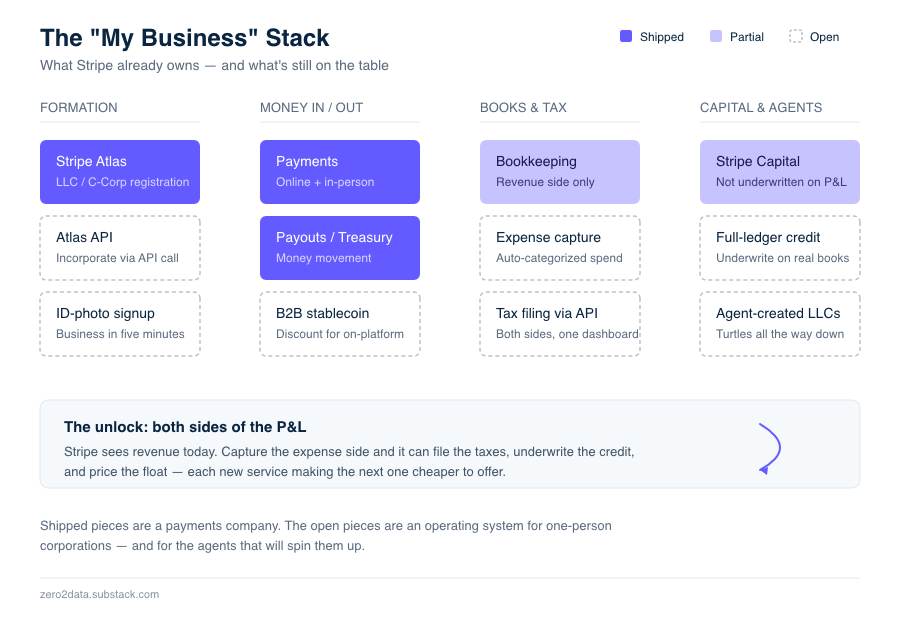
The government recognizes that reducing obstacles for entrepreneurship is critical for providing an off-ramp for displaced workers.3
Stripe already provides the following pieces to the entrepreneurship puzzle:
Payments--online and in-person
LLC/C-Corp registration via Stripe Atlas
Bookkeeping (revenue side)
Business credit (based on revenue)
Opportunities in front of them:
Convince a state (Wyoming? Nevada?) to allow for opening of LLCs via API4 - Stripe Atlas API
Create a “My Business” app that allows someone to create an LLC from within the app with a photo of their ID
Payments made via the app are automatically categorized as business expenses
File taxes via API as both sides of the P&L would lie within Stripe Dashboard
Offer stablecoin for B2B payments that, when used, gives the purchaser a small discount and gives users reason to maintain an on-platform balance
Business credit based on full on-platform P&L
Allow for trusted agents (not sure what these look like yet but I imagine we end up with a handful of platforms that we end up trusting for running economic agents on like email) to create LLCs via the API
“Start a business in five minutes with an app.”
For the pro-business, anti-tax, administration, this would be a massive win and provide an easy way for Americans everywhere to turn to entrepreneurship in opportunity or in need.
For entrepreneurs building the agent-first platforms of the future, this provides them an all-in-one finance solution.
For workers, it provides a possible path to building a business which may or may not be fulfilling work at the end of API calls.
Single-payer healthcare
A follow-up on widespread job displacement would be large-scale loss of healthcare coverage--60% of Americans under 65 obtain their health insurance via their employer. That would pressure governments--state and federal--to provide more health care coverage to citizens who can’t afford it otherwise.
AI may provide the push for America to transition to single-payer healthcare in order to expand coverage as well as means to provide employment to offset labor losses elsewhere.
Short of a single-payer system, enrollment in pooled healthcare plans via this app would be another way for the government to ease this transition.
Token tax
In order to find a way to offset potential tax revenue losses--governments will attempt to tax token consumption. Large AI providers would collect it on behalf of the governments. Those who can afford to self-host may be asked to self-report token usage on their tax forms or pay an AI-specific sales tax on top of the already steep computer-component prices.
If they go down this path, I’m not sure if politicians will have the appetite for an additional tax for on-device AI (which will become ubiquitous in a phone generation or two with Airpod and glasses coordination). That would be regressive in a way that taxing GPUs is not.
This would be a potentially politically popular tax on efficiency if companies are successfully able to transition whole roles to API endpoints backed by AI at a fraction of the cost.
That said, while token consumption may be correlated to job transfer, leveraging tokens will be a path for entrepreneurship (see point about leverage above) and may end up being taxed only on companies of a certain size.
Turtles all the way down
Entrepreneurs with corporations managing agents managing corporations.
Where we stand today is still at the base of the increasingly rapid change that AI has ahead for us. The technology is continuing to scale in learning and touch points with the economy. Workers need to be able to put AI to work to capture some of that economic activity. Stripe can provide the financial rails for selling a service in-person or for managing an army of AI agents--each of which can create their own corporation. The nodes in the economy explode.
The government will need to find a way to support this structural change in how people are employed and second-order effects such as healthcare. Reducing friction to create a business, and providing a critical service to those who run small ones, will be two of the challenges. Paying for them will be another.
The appetite for data is so large that data is being generated for the sole purpose of training models. Humans can’t keep up.
It is cheaper and faster to experiment than ever before with more data providing better results.
This is something that cities recognized when they relaxed certain food preparation laws during COVID.
See my previous Corporations as an API post